
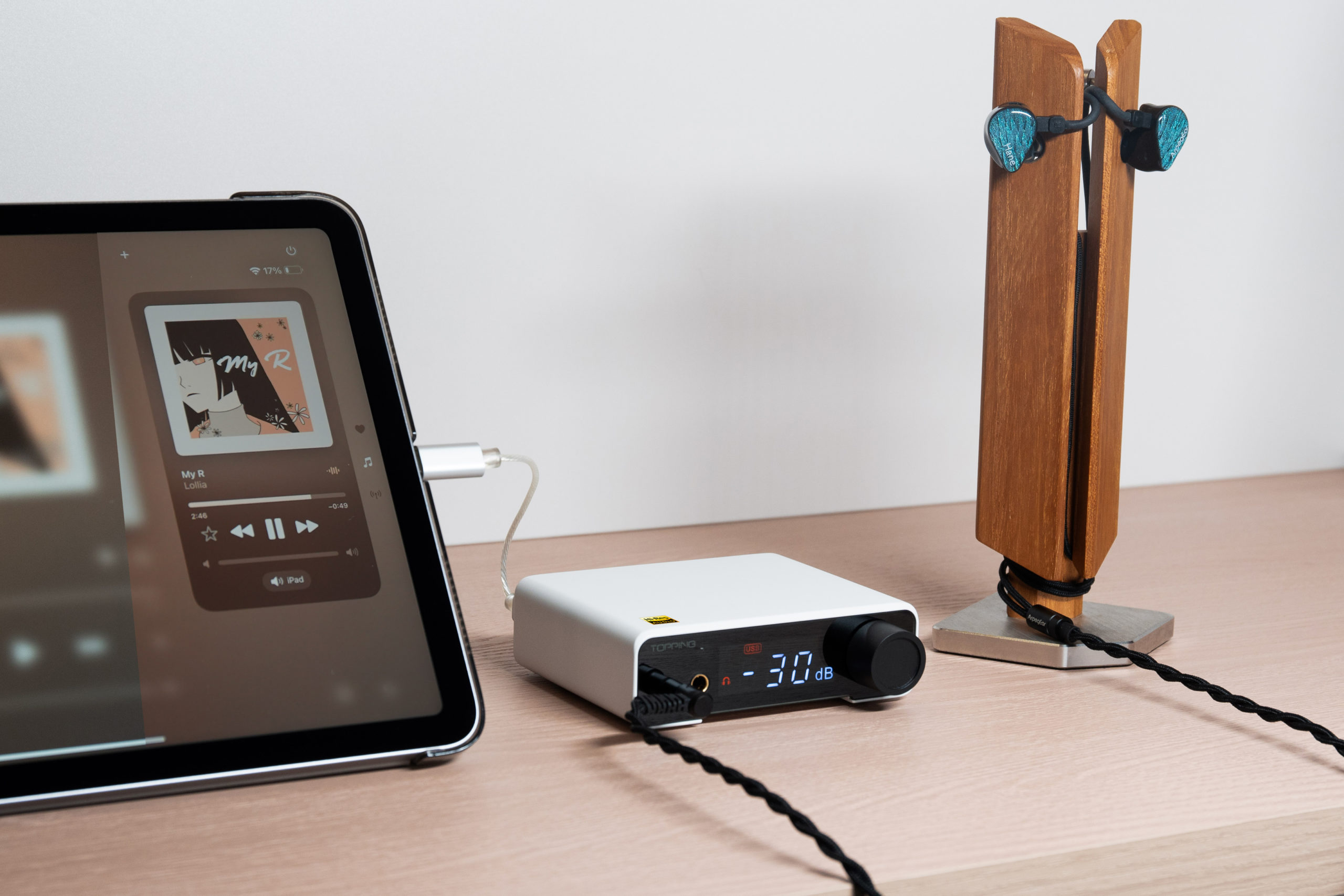
Topping DX1 II – elevate audio with music & more
The new Topping DX1 II is a first-rung audio upgrade – a budget-friendly DAC/headphone amp for people seeking better sound quality when they listen to music, play games and enjoy other forms of audio and AV content, from podcasts to YouTube. Despite its diminutive size and price tag, its internal design delivers excellent sound – engagingly crisp, detailed and dynamic – with a specification that includes gaming-ready features and makes the DX1 II an all-round sub-£150 game-changer.
Measuring just 10×3.2x10cm (WxHxD) and weighing 275g, the DX1 II is small and light enough to be easily portable, with an aluminium enclosure sufficiently robust to throw in a bag and take on your travels. It contains sophisticated DAC and headphone amp circuitry to upgrade the basic audio tech in 1 all sorts of digital devices – laptop and desktop computers, games consoles, media streaming devices and more. It doesn’t require its own power source, receiving both power and audio data from the device to which it’s connected. And it delivers a perfectly processed, optimally amplified analogue audio signal to headphones, powered speakers, or an amp and separate speakers.
With an RRP of just £119, Topping’s tiny DAC/amp provides the key to unlock bigger, bolder, more detailed sound, elevating your digital entertainment experience to a thrilling new level.
Versatile connections – including gaming-ready features
The DX1 II packs in a range of connections that put many of its price-point competitors in the shade. Digital audio inputs are covered by a USB-C port and an optical socket, the latter twinned with an optical output. The provision of both input types means the DX1 II can be used with a wider range of digital gear – CD players, TVs and games consoles, for example, as well as PCs/Macs and Android/iOS devices – to elevate audio and connect headphones.
Furthering this flexibility, the USB-C input can switch between USB Audio Class 1.0 and 2.0 via a control on the back. While most connected devices will be compatible with UAC 2.0, some – the PlayStation 5 and Nintendo Switch, for example – rely solely on UAC 1.0. Providing both protocols ensures that all devices able to output digital audio over USB will work with the DX1 II.
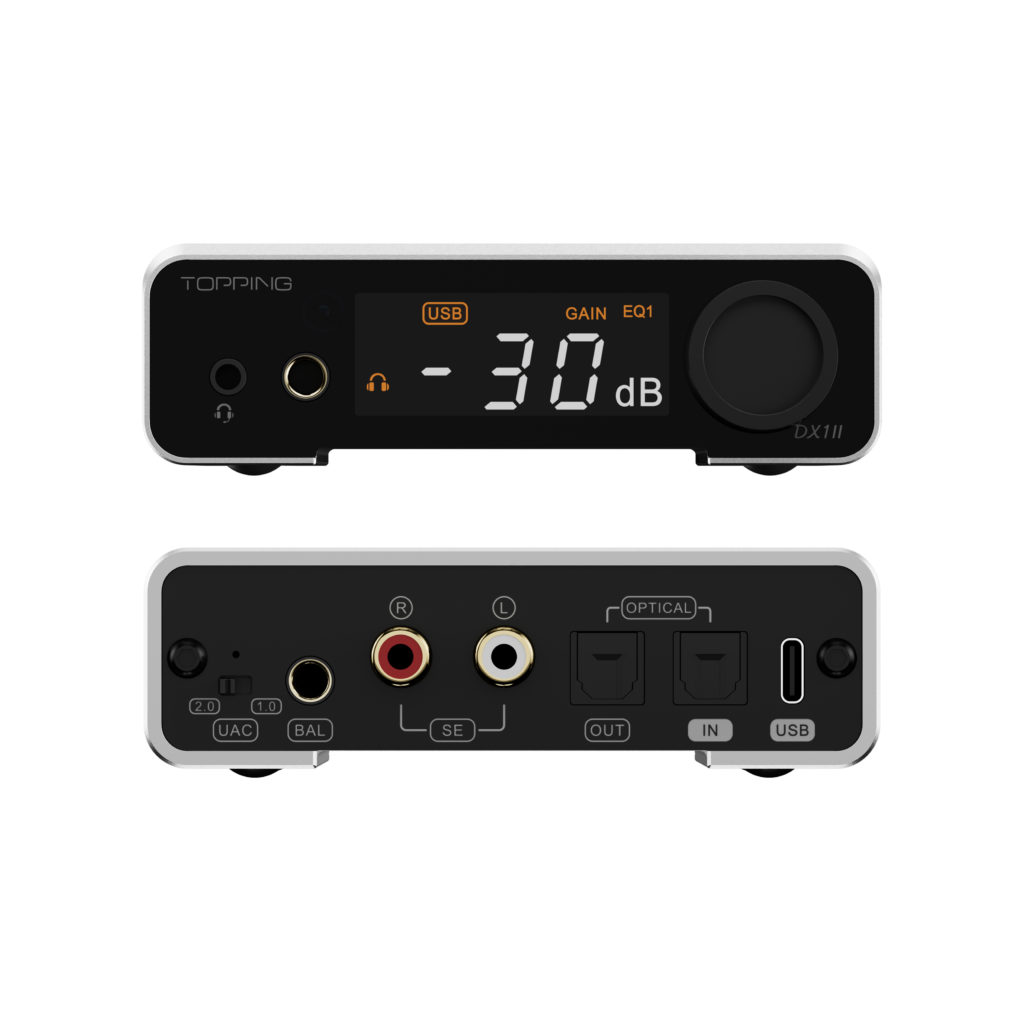
Two headphone outputs are supplied – 3.5mm and 4.4mm, the latter for balanced connections with suitably equipped headphones. Many DAC/headphone amps claim to be good for gamers, but few include a microphone input for gaming headsets – the DX1 II’s 3.5mm socket provides two-way communication, so as well as delivering audio to the connected headset it also receives audio from the headset’s mic. This is a fantastic feature for online gamers – as well as ensuring the game’s audio effects are delivered with maximum impact, the clarity of voice communication between players is also elevated. And the mic input on the 3.5mm socket is great for voice and video calls too.
In addition to the headphone outputs, the DX1 II includes line outputs in stereo RCA and balanced 4.4mm flavours, to connect to an amp and speakers. These can be used in fixed-level mode (to feed an integrated amp or preamp) or preamp mode, which engages the DAC’s built-in volume control to link directly to a power amp or active speakers.
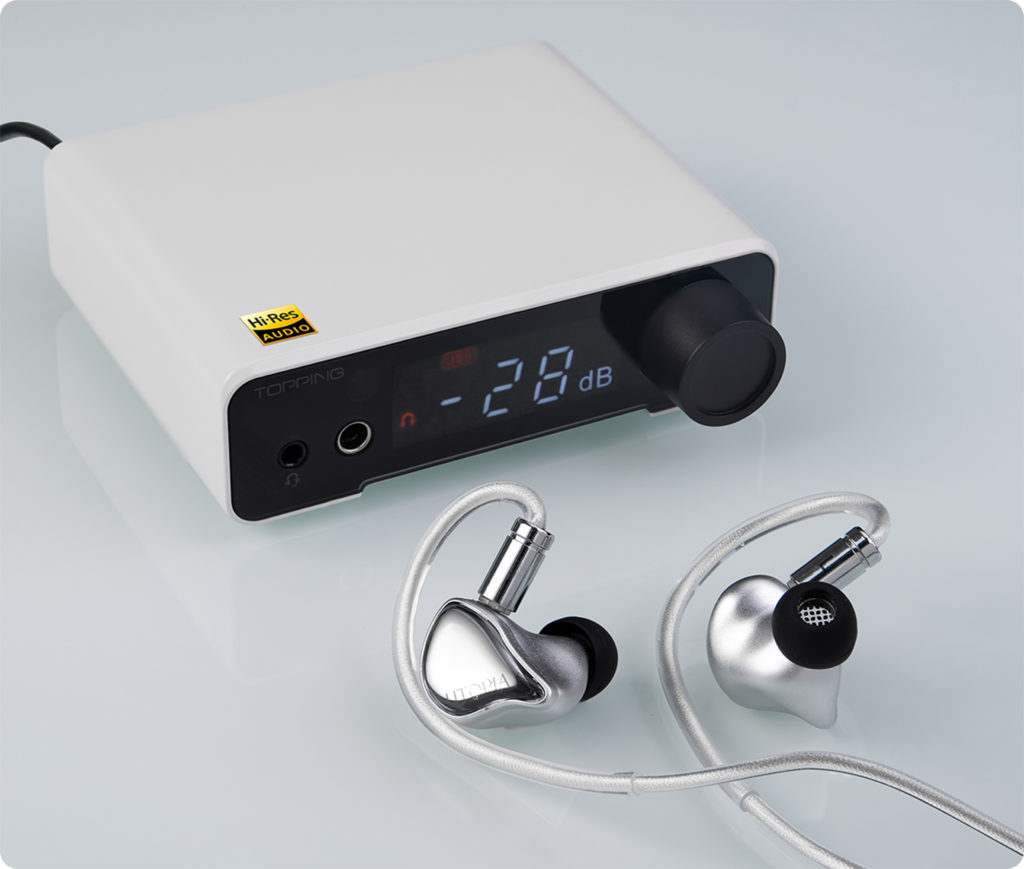
Talking technical: what’s under the hood of the Topping DX1 II?
The DX1 II draws from the experience Topping has gained in developing a range of class-leading DACs at a wide spread of prices, from under £200 to close to £2,000. Its digital-to-analogue conversion stage is built around the ES9039Q2M – a new-generation 32-bit chip from ESS Technology’s Sabre 32 Reference range, often used in much more expensive DACs. This chip features the company’s latest HyperStream IV technology and Dual DAC architecture, which integrates two individual D-to-A convertors on a single chip to process the left and right audio channels independently.
This combines with Topping’s pre-and post-DAC circuitry – including a high-end, 16-core XU-316 XMOS chip for input signal processing – to deliver an exceptionally high dynamic range and ultra-low noise, whilst eradicating channel crosstalk. The analogue circuitry fed by the DAC stage features a fully balanced architecture, maintaining the channel separation that begins at the point of digital-to-analogue conversion to further lower the noise floor, reduce distortion and contribute to the excellent sound quality from all outputs, whether line or headphone.
The headphone amp stage incorporates four independent channels delivering separate left and right signal paths, the full benefits of which are reaped via the 4.4mm balanced output. This not only provides strong driving power and control, but also further improves resolution, dynamics and imaging.
Using the latest electronic components, it isn’t hard to design a low-cost headphone amp that delivers plenty of power. But designing one that does this whilst achieving a genuinely quiet background, without significantly raising the price, is much trickier. Topping went to great lengths with the DX1 II’s amp design to lower the noise floor to vanishingly low levels, ensuring a clean, silent, inky-black background for your music through even the most sensitive IEMs (In-Ear Monitors).
The DX1 II takes its power from the connected source device over USB (5V), keeping cable clutter to a minimum. To optimise performance, Topping developed its own discrete, low-noise internal power supply circuitry, delivering independent, clean and stable power to the critical DAC and analogue amplification stages. This is another example of the attention to technical detail driving sound quality that outclasses the price-point competition. Performance by numbers The DX1 II supports incoming digital audio signals to 32-bit/384kHz PCM and native DSD256 over its USB-C input. The optical input supports 24-bit/192kHz PCM and DSD64 (DoP). All of which means the 3 DAC will handle whatever you through at it, from compressed audio streams to lossless hi-res. Even the mic input on the 3.5mm headphone socket supports 24-bit/192kHz audio for crystal-clear voice comms.
Technical performance is impressive across all measured parameters, matching or exceeding DACs that are much more expensive. A Signal-to-Noise Ratio of 128dB @ 1kHz is achieved through the balanced line and headphone outputs, with the same figure applying to dynamic range. THD+N (Total Harmonic Distortion plus Noise) is as low as <0.00007% on the balanced line output. All of which illustrates the exceptional resolution and clarity of which Topping’s little DAC/amp is capable.
The headphone amp stage generates sufficient power to drive tough loads like planar magnetic designs, delivering 2x 1000mW into 32 ohms and 64 ohms, and 2x 230mW into 300 ohms. Click here for more technical data.
Precision sonic tuning
Topping has been rolling out its Parametric EQ (PEQ) system in all its new-generation DACs and the DX1 II is no exception, despite its diminutive price tag. PEQ allows precise control of frequency, gain and Q (bandwidth) across ten customisable bands – this enables the sound to be precisely tuned to suit the connected equipment, and the differing characteristics of digital sources and acoustic environments, in line with one’s personal sonic taste.
There are two ways of operating the PEQ facility. The first is to use the free Topping Tune app for PCs and Macs, enabling owners to dial in values or import target curves and save up to three custom profiles directly to the DX1 II’s hardware memory. The second is the new Topping Home Web online control centre, accessible via any internet browser – this features a drag-and-drop interface for easier tuning, along with the ability to apply community-shared profiles.
The provision of an optical digital output allows the DX1 II to be used as a signal processor between the source device and another DAC. This means the benefits of 10-band PEQ tuning can be applied to any set-up, even if the DX1 II’s DAC and headphone amp are not required.
In addition to the PEQ system, the DX1 II offers eight user-selectable digital filter settings for subtle sonic tuning. The headphone amp supplies two gain settings, tailoring the amount of amplification applied to the input signal (before the volume control) to suit the varying sensitivities of headphones and IEMs.
Technical excellence delivers great sound – for music, games and more
The DX1 II’s sound is transparent and finely detailed – remarkably so for its price – with strong dynamics, excellent transient response and a spacious soundstage. Bass is taut and clean, midrange clear and expressive, and treble crisp and extended – all of which translates to a thoroughly engaging highdefinition performance with all manner of music.
The diminutive DAC/amp’s functional versatility extends to its performance with other media. Voices in podcasts and radio shows are conveyed with clarity and realistic tonality; movies and video content are delivered with crisply resolved detail in quiet moments and high impact when the soundtrack heats up.
For gamers, as well making the action more immersive the DX1 II gives them a competitive edge. Footsteps, ambient cues and gunfire are rendered with greater precision, sharpening positional awareness in games like first-person shooters. Plus, the PEQ facility enables experienced gamers to set custom sound profiles to suit different games.
Simple operation, sophisticated performance
Many small DACs at comparable prices neglect features that enhance usability, such as a display and remote control – but not the DX1 II. Flanked by the headphone sockets and a multifunction rotary control, its central LED display shows volume level and sample rate in large digits, accompanied by other information such as input/output selection, DSD format indication, PEQ setting and headphone gain.
The display can be set to various brightness levels or turned off completely; other convenience features include automatic standby and wake-up, which can be disabled if preferred. A remote control is supplied, making it easy to engage the tiny Topping’s useful range of features from any position in the room. Two USB cables – USB-C to USB-C, and USB-A to USB-C – are also provided.
A real sub-£150 game-changer, the Topping DX1 II DAC/headphone amp is available from July in a choice of black, white or silver at an RRP of £119 – brought to the UK by Electromod, Topping’s UK distributor. As with all Topping products, customers who purchase the DX1 II from an official UK stockist benefit from a two-year warranty and UK-based tech and servicing support.

TOPPING
Formed in 2008, Topping has forged a formidable reputation for first-rate audio design and engineering that puts its competitors in the shade. The company’s range includes class-leading DACs of various ‘flavours’, some using ESS Technology or AKM chips, others incorporating R2R or proprietary discrete 1-bit DAC technologies, to cater for a wide variety of tastes and preferences. Amplifiers are another speciality, from analogue headphone amps to match the various DACs, to stereo and mono amps for loudspeakers. All punch well above their price points. toppingaudio.com