Luxman B-100 Centennial
The Luxman B-100 Centennial provides power for the ages.
Japan’s premier upscale audio manufacturer continues to celebrate its centenary with the launch of its finest-ever power amplifier: the Luxman B-100 Centennial
Yokohama, Japan — When Luxman turned 100 last year, Japan’s most venerable high-end audio manufacturer announced plans to celebrate with a series of flagship products representing the pinnacle of its achievements. The P-100 Centennial headphone amplifier arrived first, followed by the L-100 Centennial integrated amplifier and D-100 Centennial CD/SACD player. Now, Luxman is unleashing the ultimate expression of its amplifier engineering as its next centennial arrival.
The Luxman B-100 Centennial – or B-100C – is their first mono power amplifier since the B-1000f, which launched two decades ago to mark the company’s 80th anniversary. Luxman has poured everything into it – its Class A heritage, its latest LIFES 1.1 feedback engine, zero-compromise 4×4 architecture and build quality that is simply unsurpassed. The result is a remarkable statement of Luxman’s engineering prowess, delivering one of the most significant high-end amplifiers of not just this year, but any year.
The B-100C was previewed at the High End audio show in Vienna in June; now Luxman is ready to ship worldwide. As with the rest of Luxman’s superb range, the amp is brought to these shores from Japan by IAG UK, Luxman’s UK distributor. The price of ownership is £44,000 for a stereo pair.
A class apart
One of the things Luxman is most famous for is its fabulous Class A amplifiers. Class A is a type of amp design where the active output devices – transistors or valves – conduct current throughout the entire 360-degree signal cycle. In simple terms, they remain conducting continuously, rather than handing over amplification between devices as the music waveform changes. This eliminates crossover distortion and can deliver excellent linearity, which is why Class A is often regarded by audiophiles as a particularly refined approach to amplification.
The trade-off is low efficiency and high heat generation. Class A amplifiers consume substantial power even when delivering relatively modest output levels, while high-power designs demand particularly large power supplies and extensive heatsinking. Class AB, by contrast, combines Class A operation at lower signal levels with Class B-like operation at higher levels, improving efficiency and making much higher output power more practical. It is therefore the more common choice, although many audiophiles remain attracted to the linearity and sonic purity associated with Class A operation.
Best of both worlds
The Luxman B-100 is an amp of awesome ability The B-100C delivers 125 watts into 8 ohms, rising to 250 watts into 4 ohms, with an instantaneous peak output of 1,000 watts into 1 ohm. This formidable power reserve, coupled with substantial current delivery, equips the amplifier to drive even the most demanding loudspeaker loads with authority. Achieving this level of output in a pure Class A design would require an exceptionally large power supply and generate significant heat. Luxman’s solution is an ingenious output-stage architecture that combines the benefits of Class A and Class AB operation.
The Luxman B-100C operates in pure Class A up to 25 watts (into 8 ohms), with the output devices conducting continuously throughout the signal cycle. Beyond this level, the amplifier transitions into Class AB, allowing it to supply substantially greater power without the heat and power consumption that continuous Class A operation at such levels would entail.
The B-100C is not the first high-end amplifier to combine Class A for the first few watts with Class AB at higher output levels, but Luxman’s implementation is particularly refined, ensuring a seamless transition between the two. Delivering crystalline clarity, natural flow and effortless dynamic range, its performance remains remarkably consistent across a wide range of music and with a variety of loudspeakers, from low listening levels to concert-like volumes.
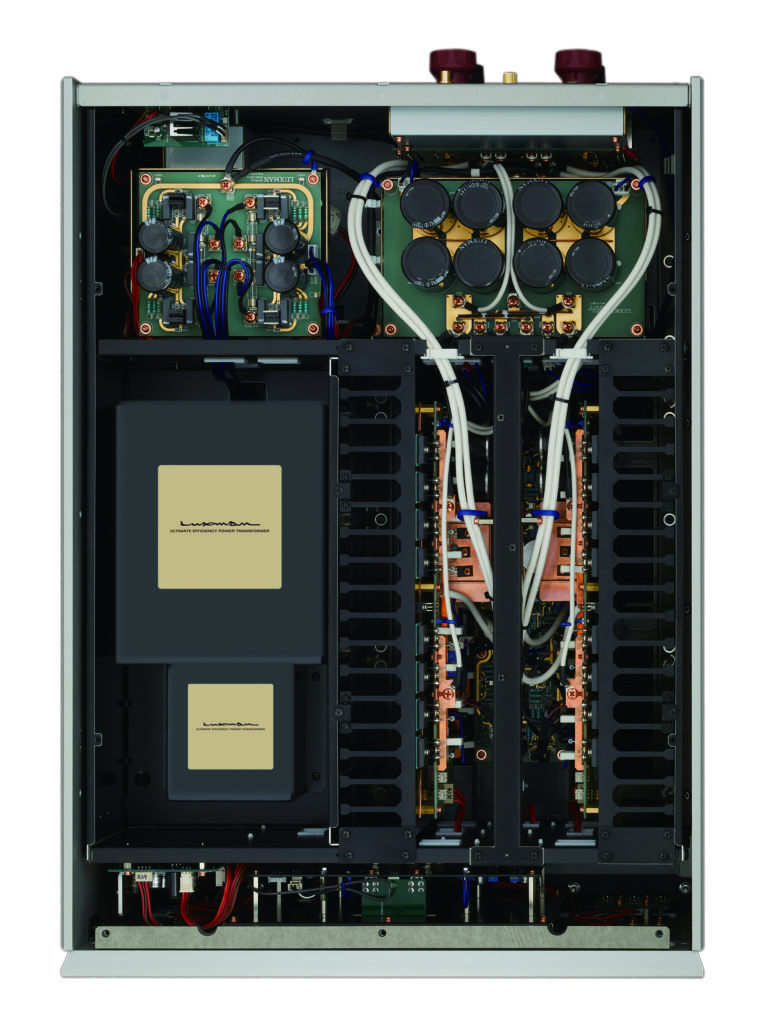
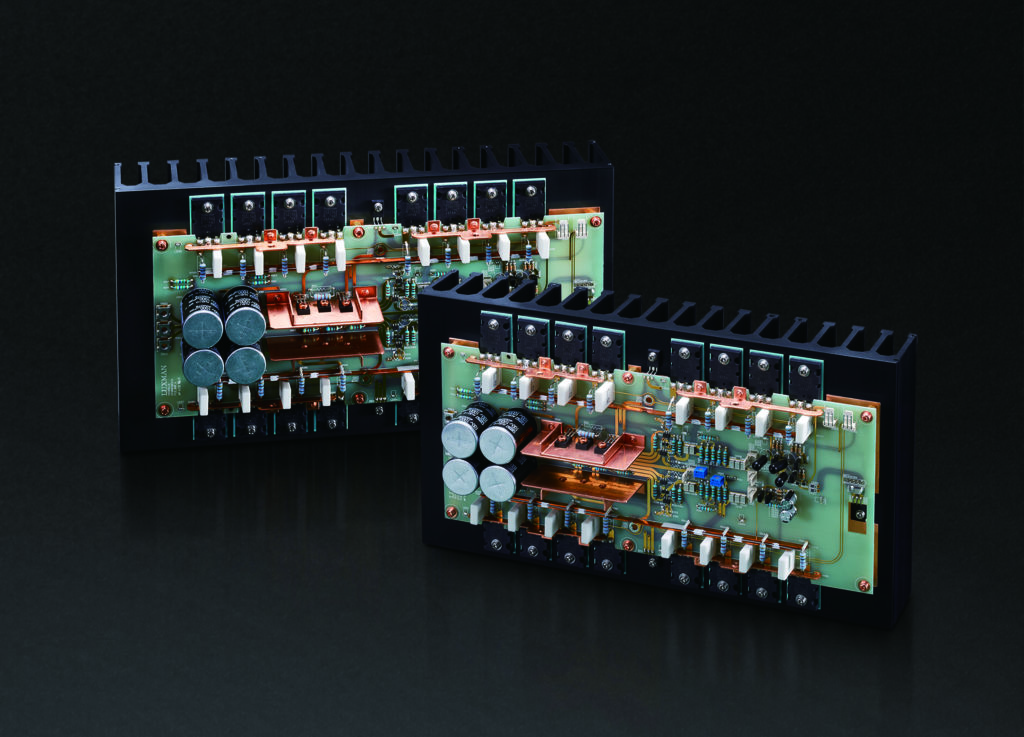
The B-100C’s output stage employs a 4×4 configuration, with four quadruple-paralleled, triple-stage Darlington push-pull modules per amplifier. Its power supply features a highly stable EI-core transformer with flat copper windings, designed to minimise losses and ensure strong coupling, backed by sixteen 10,000μF filter capacitors providing a total capacitance of 160,000μF. The result is outstanding linearity, abundant energy and vice-like control, combined with a natural, open and deeply expressive sound.
Choose LIFES
At the heart of the B-100C’s architecture is LIFES 1.1, the latest evolution of Luxman’s proprietary amplifier feedback circuit. Standing for ‘Luxman Integrated Feedback Engine System’, LIFES builds on the company’s ODNF technology, feeding back only the distortion components detected by comparing the input and output signals, rather than the original music signal itself.
This approach is designed to combine the low distortion, linearity and stability associated with negative feedback with the natural openness and vitality often attributed to non-feedback designs. In LIFES 1.1, Luxman has further refined the circuit by using parallel differential-detection circuitry to reduce distortion and improve precision.
In the B-100C, this advanced feedback architecture contributes to exceptionally low measured distortion, while underpinning Luxman’s aim of delivering outstanding transparency, transient precision and resolution without sacrificing musical naturalness.
All about the details
Luxman has gone to extraordinary lengths to remove any hint of compromise from the B-100C’s design. 100 micrometre-thick, gold-plated, peel-coat printed circuit boards are used throughout every audio signal stage. By removing the solder mask and residual flux from signal paths, dielectric effects are minimised, which further preserves signal integrity and particularly benefits high frequencies.
To achieve the loudspeaker drive capability demanded of a reference-class monaural power amplifier, every aspect has been engineered for ultra-low impedance signal transmission. Newly developed largegauge output conductors carry the amp’s output signal with minimal resistance, paired with a newly designed heavy-duty output coil and low-resistance speaker relays.
Every circuit component has been carefully considered – not just major elements such as the power transformer and high-capacity filter capacitors, but every resistor, capacitor and internal connection wire has been meticulously evaluated before selection. Luxman works closely with leading component manufacturers to repeatedly prototype and conduct extensive listening tests to ensure every internal part meets its uncompromising standards. In a world of ubiquitous circuit designs and common component choices, Luxman’s obsessive attention to detail ensures its amplifiers are genuinely unique
Uncompromising on the outside too
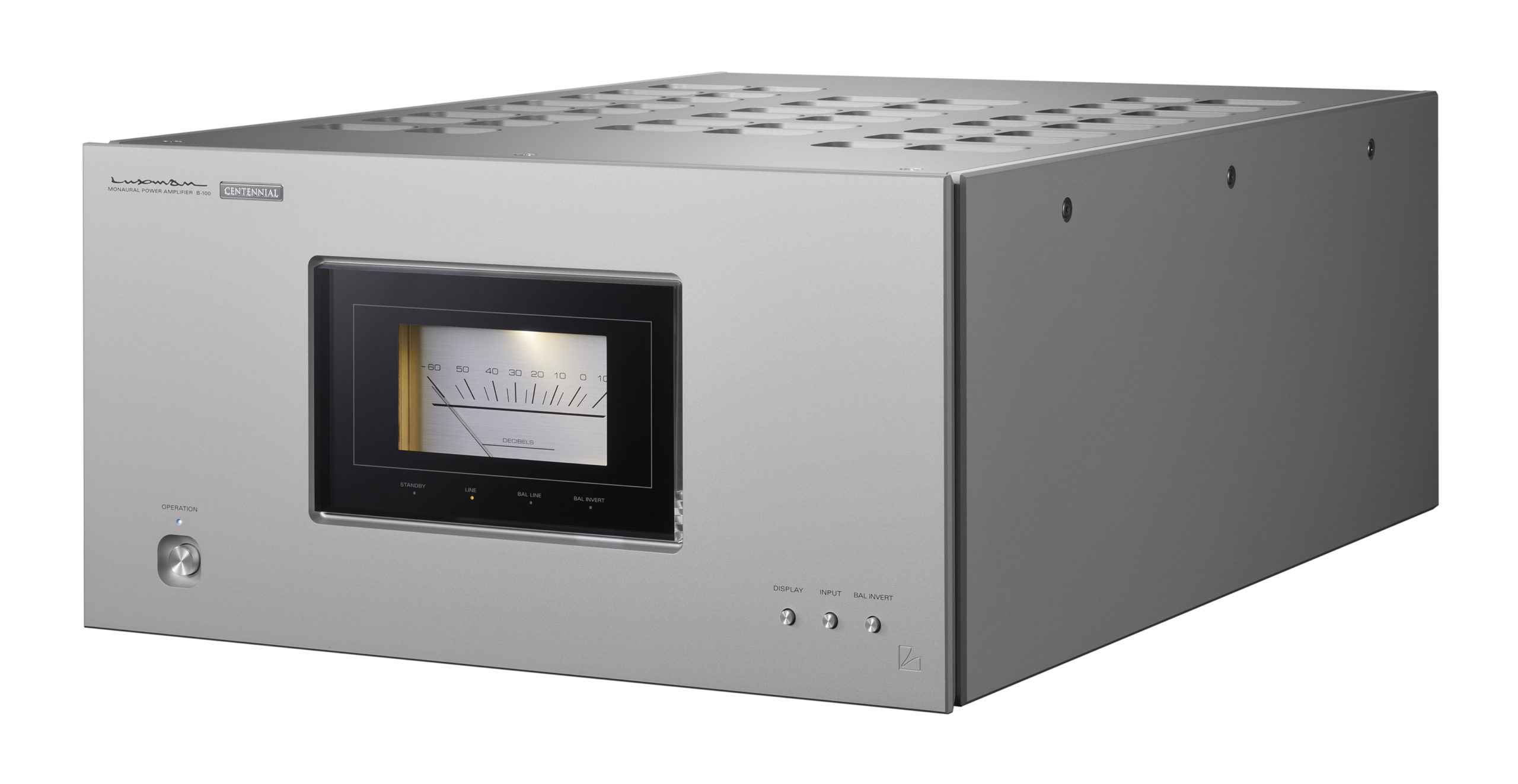
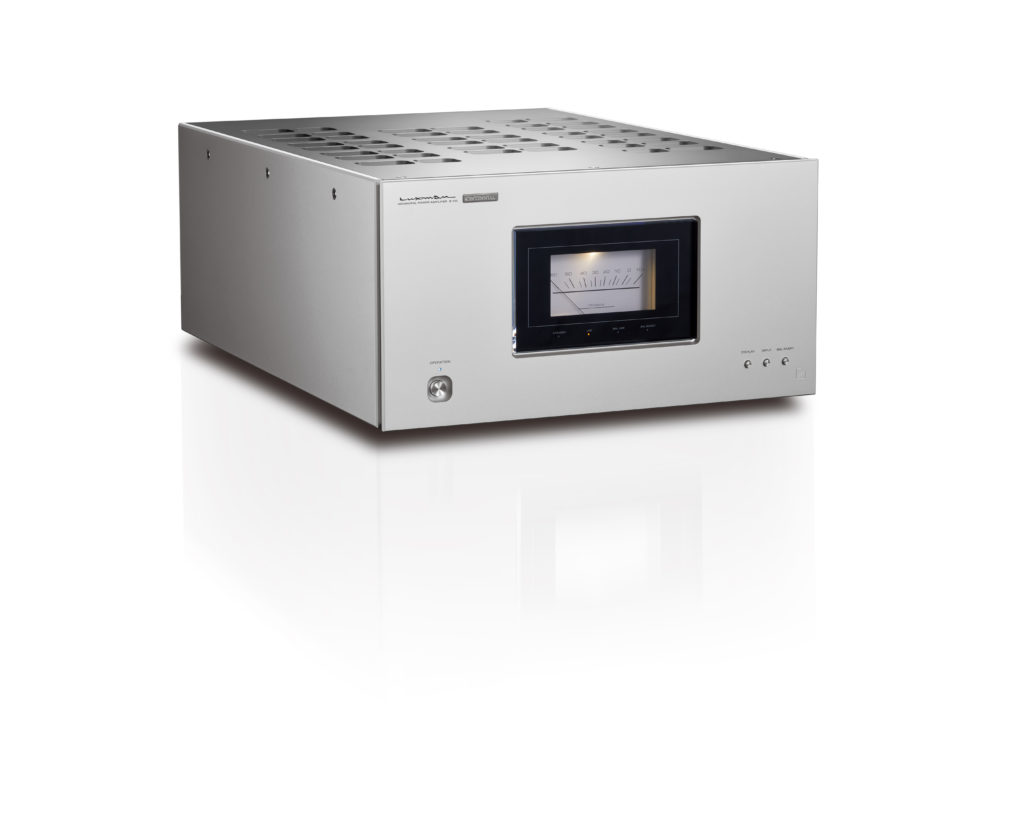
Finished in Luxman’s signature ‘Blasted White’ silver finish, the B-100C commands attention with its imposing proportions: 440mm wide, 243mm high and 651mm deep. It features Luxman’s loop-less chassis construction, engineered to eliminate increases in ground impedance caused by chassis currents while isolating the circuitry from unwanted magnetic interference.
Its foundation is an exceptionally rigid dual-layer chassis base, formed by laminating 2.3mm and 3.2mm steel plates into a robust 5.5mm-thick structure. Supporting the amplifier are specially designed cast-iron density gradient isolation feet, engineered to block external vibrations while efficiently dissipating vibrations generated within the chassis itself.
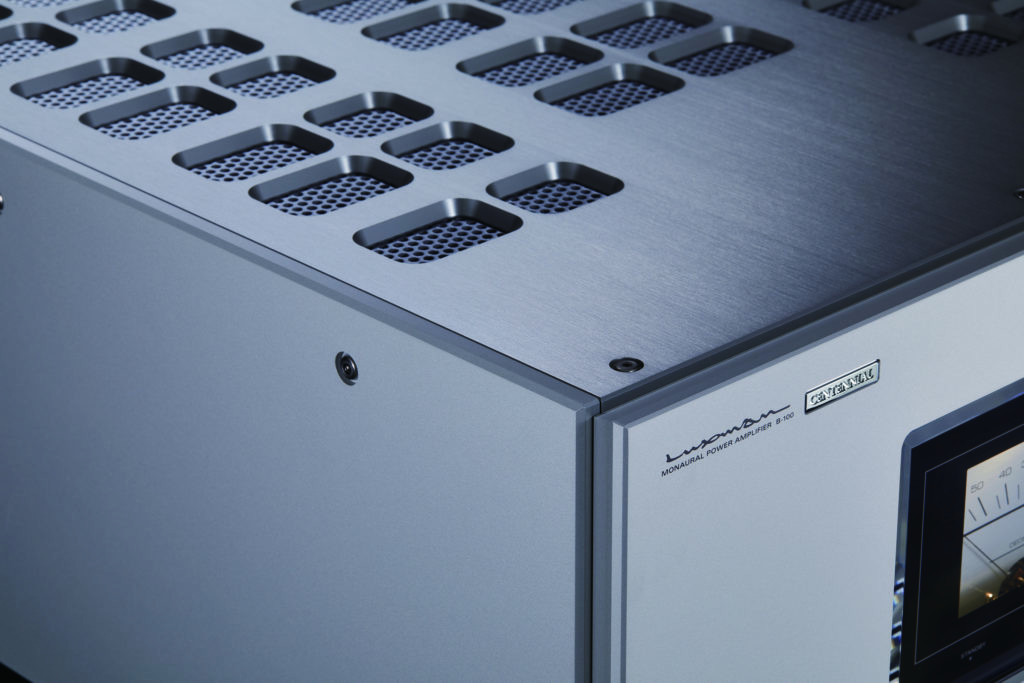
Closer inspection reveals the quality of finer details. The 5mm-thick top panel features ventilation openings machined to perfection, while the 15mm-thick front panel sports distinctive slanted edging, like the seam detail of a finely tailored jacket.
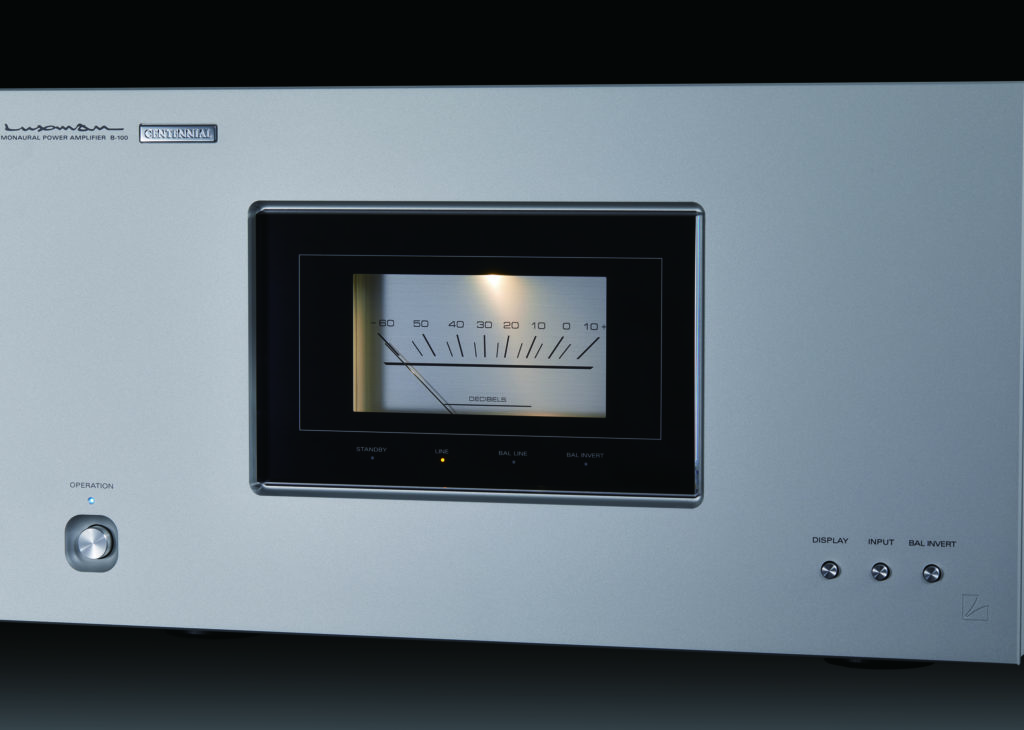
A large analogue meter sits front and centre, showing real-time signal output as its needle dances to the music. Soft white LEDs cast a warm, incandescent shower of light across the meter’s face, creating a timeless ambience while complementing the amplifier’s crisp styling. Positioned beneath the meter, a series of LED status indicators provide clear operational information.
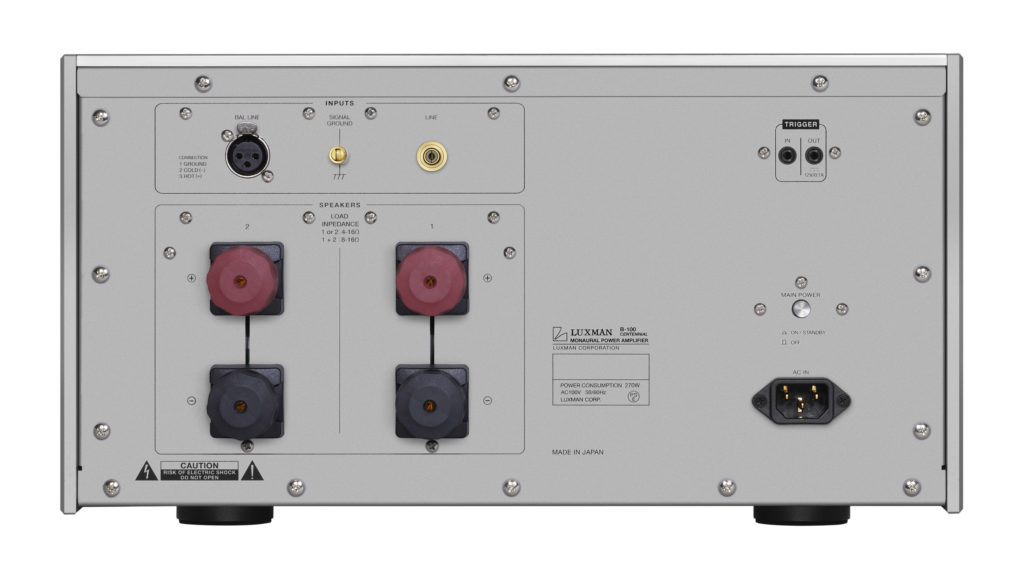
The removal of compromise continues around the back. Many amps, even acclaimed high-end models, use standard input and output terminals but here they are of the highest grade, from Luxman’s highly rigid RCA terminals and Neutrik XLR connectors to heavy-duty speaker binding posts. Even the AC inlet is engineered to provide exceptional mechanical stability and long-term reliability.
The B-100C monaural power amp – Luxman’s new flagship amplifier – is available in the UK from October at an RRP of £44,000 for a stereo pair (or £22,000 each).